Buy inspiracija.eu ?
We are moving the project
inspiracija.eu .
Are you interested in purchasing the domain
inspiracija.eu ?
domain@kv-gmbh.de · 0541-91531010
Buy inspiracija.eu ?
Is allosteric inhibition the same as non-competitive inhibition?
Allosteric inhibition and non-competitive inhibition are not the same, although they are related. Non-competitive inhibition refers to the binding of an inhibitor to a site on the enzyme that is not the active site, thereby preventing the substrate from binding to the active site. Allosteric inhibition, on the other hand, occurs when an inhibitor binds to a site on the enzyme that is distinct from the active site, causing a conformational change in the enzyme that reduces its activity. While both types of inhibition involve the binding of an inhibitor to a site other than the active site, allosteric inhibition specifically involves a change in the enzyme's shape and activity. **
What type of inhibition occurs through allosteric activation/inhibition?
Allosteric inhibition occurs when a molecule binds to an allosteric site on an enzyme, causing a conformational change that reduces the enzyme's activity. This type of inhibition is non-competitive, meaning it does not compete with the substrate for the active site. Allosteric activation, on the other hand, occurs when a molecule binds to an allosteric site and enhances the enzyme's activity. Both allosteric inhibition and activation involve the binding of a regulatory molecule to a site other than the active site of the enzyme, leading to a change in the enzyme's activity. **


Similar search terms for Inhibition
Top-Angebote
Products related to Inhibition:
-
bareMinerals Mineralist Gloss-Balm-ImaginationDrench lips with sheer colour and glossy shine. Enriched with sustainably sourced fruit oils, this vegan lip gloss-balm delivers instant nourishment in a cushiony, non-sticky formula. Lips feel softer, smoother and more hydrated over time - even after you take it off. The cap and vial are made with post-consumer recycled plastic. Get the best of gloss and balm in one: sheer colour, high-shine and irresistibly soft lips. 90% said their lips felt instantly hydrated* Delivers up to 50% smoother lips in just 1 week* Based on a 1-week clinical study with 30 people. Results may vary. Dermatologist-tested. Shades: • Ambition • Clarity • Enlightenment • Heart • Imagination • Ingenuity • Love • Peace • Serenity • Sincerity • Trust • Vision • Wonder • Zen Ingredients Ambition, Clarity, Enlightenment, Heart, Imagination, Ingenuity, Love, Peace, Serenity, Sincerity, Trust, Vision, Wonder, Zen: Diisostearyl Malate, Phenyl Dimethicone, Triisostearyl Citrate, Glyceryl Behenate, Helianthus Annuus (Sunflower) Seed Wax, Simmondsia Chinensis (Jojoba) Seed Oil, Punica Granatum Flower Extract, Hippophae Rhamnoides Oil, Prunus Domestica Seed Oil, Ascorbyl Palmitate, Tocopherol, Silica Dimethyl Silylate, Calcium Stearate, Polyglyceryl-2 Triisostearate, Flavor (Aroma), Linalool. May Contain/Peut Contenir (+/-): Mica, Titanium Dioxide (Ci 77891), Iron Oxides (Ci 77491, Ci 77492, Ci 77499), Blue 1 Lake (Ci 42090), Red 7 Lake (Ci 15850), Red 28 Lake (Ci 45410), Yellow 5 Lake (Ci 19140).15,60 £*Shipping: 2,95 £Secure redirect to the provider
-
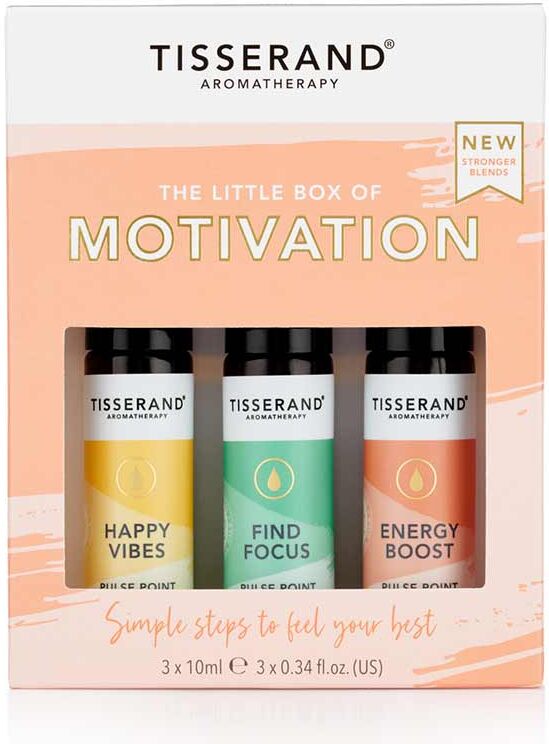
Tisserand The Little Box of Motivation 3x10mlRevitalise and revive your mind with Tisserand's Little Box of Motivation, including 3 pulse point roller balls. Contents • Happy Vibes Roller Ball 10ml • Find Focus Roller Ball 10ml • Energy Boost Roller Ball 10ml Formulated with 100% natural pure essential oils, these roller balls can be applied at the temples, neck and wrists or apply behind the ears. Wake up and be ready for the day ahead with these mood-enhancing roller balls. Tisserand Happy Vibes Pulse Point Roller Ball is designed to provide stamina during tiring moments. Formulated with euphoric bergamot oil, energising grapefruit oil and uplifting lime oil. Finding focus certainly isn't always easy. Provide your body and mind with an instant burst of focus with the Tisserand Find Focus Pulse Point Roller Ball. The perfect blend, enriched in Peppermint, soothing Lavender and uplifting Lemon, this is an aromatherapy roller ball with drive! Tisserand Energy High Pulse Point Roller Ball is designed to ease tension in the head, providing a cool release. Formulated with cooling white mint oil, restorative lavender oil and reviving lemon oil. Ingredients Happy Vibes Roller Ball: Caprylic/Capric Triglyceride, Amyris Balsamifera (Amyris) Bark Oil, Citrus Aurantium Bergamia (Bergamot) Peel Oil, Leptospermum Petersonii (Lemon Tea Tree) Oil, Citrus Aurantium Amara (Petitgrain) Leaf/Twig Oil, Mentha Citrata Herb Oil, Myristica Fragrans (Nutmeg) Kernel Oil, Linalool*, Limonene*, Geraniol*, Citral*, Farnesol*. Find Focus Roller Ball: Caprylic/Capric Triglyceride, Rosmarinus Officinalis (Rosemary) Leaf Oil, Citrus Paradisi (Grapefruit) Peel Oil, Cedrus Deodara (Cedarwood) Wood Oil, Coriandrum Sativum (Coriander) Seed Oil, Citrus Aurantium Amara (Petitgrain) Leaf/Twig Oil, Pelargonium Graveolens (Geranium) Oil, Jasminum Officinale (Jasmine) Flower Oil, Lavandula Angustifolia (Lavender) Oil, Tocopherol, Limonene*, Linalool*, Geraniol*, Citronellol*, Citral*, Benzyl Benzoate*, Benzyl Alcohol*, Eugenol*, Benzyl Salicylate*. Energy Boost Roller Ball: Caprylic/Capric Triglyceride, Citrus Aurantium Dulcis (Orange) Peel Oil, Citrus Aurantifolia (Lime) Peel Oil, Citrus Aurantium Bergamia (Bergamot) Peel Oil, Citrus Paradisi (Grapefruit) Peel Oil, Citrus Aurantium Amara (Petitgrain) Leaf/Twig Oil, Coriandrum Sativum (Coriander) Seed Oil, Cupressus Sempervirens (Cypress) Leaf Oil, Juniperus Communis (Juniper Berry) Fruit Oil, Limonene*, Linalool*, Citral*, Geraniol*. *Naturally occurring within essential oils10,59 £*Shipping: 2,95 £Secure redirect to the provider


-
What is the difference between competitive inhibition and allosteric inhibition?
Competitive inhibition occurs when a molecule competes with the substrate for the active site of an enzyme, effectively blocking the substrate from binding and inhibiting the enzyme's activity. In contrast, allosteric inhibition occurs when a molecule binds to a site on the enzyme other than the active site, causing a conformational change that reduces the enzyme's activity. While competitive inhibition directly competes with the substrate for the active site, allosteric inhibition involves binding to a different site on the enzyme to regulate its activity. **
-
Is allosteric inhibition irreversible?
Allosteric inhibition is typically reversible, meaning that the inhibitor can bind to the allosteric site and block the activity of the enzyme, but can also dissociate from the site, allowing the enzyme to regain its activity. This is in contrast to irreversible inhibition, where the inhibitor forms a covalent bond with the enzyme, permanently inactivating it. **
-
Non-competitive inhibition, right?
Non-competitive inhibition is a type of enzyme inhibition where the inhibitor binds to a site on the enzyme that is not the active site. This binding causes a conformational change in the enzyme, making it less effective at catalyzing the reaction. Non-competitive inhibitors do not compete with the substrate for binding to the enzyme. Instead, they can bind to the enzyme-substrate complex or to a separate allosteric site on the enzyme. **
-
What is allosteric inhibition?
Allosteric inhibition is a type of enzyme regulation where a molecule binds to a site on the enzyme that is different from the active site, causing a conformational change in the enzyme's structure. This change reduces the enzyme's activity and ability to bind to its substrate, ultimately inhibiting its function. Allosteric inhibition is a reversible process and can be used to regulate enzyme activity in response to changing cellular conditions. **


What is the difference between allosteric inhibition and competitive inhibition in biology?
Allosteric inhibition occurs when a molecule binds to an allosteric site on an enzyme, causing a conformational change that reduces the enzyme's activity. This type of inhibition is non-competitive and can affect multiple enzymes in a metabolic pathway. On the other hand, competitive inhibition occurs when a molecule competes with the substrate for the active site of the enzyme, effectively blocking the substrate from binding and reducing the enzyme's activity. Competitive inhibition can be overcome by increasing the concentration of the substrate, while allosteric inhibition cannot be overcome in the same way. **
What is the difference between non-competitive inhibition and allosteric inhibition in biochemistry?
Non-competitive inhibition occurs when an inhibitor binds to an enzyme at a site other than the active site, causing a conformational change in the enzyme that reduces its activity. This type of inhibition does not compete with the substrate for binding to the active site. On the other hand, allosteric inhibition occurs when an inhibitor binds to an allosteric site on the enzyme, causing a conformational change that reduces the enzyme's activity. Allosteric inhibition can be reversible or irreversible, and it can be overcome by increasing the concentration of the substrate. **
Top-Angebote
Products related to Inhibition:
-
Smells Like Spells Norse Magic Bragi incense sticks (inspiration/creativity) 50 gSmells Like Spells Norse Magic Bragi, 50 g, Incense Sticks Home Scents, Smells Like Spells Norse Magic Bragi incense sticks are suitable for scenting spaces and creating a pleasant atmosphere. They help prevent stress, have a positive effect on the human psyche, calm the mind and are also a disinfectant. Characteristics: a fresh fragrance a herbal aroma How to use: Light the end of the incense stick and blow out the flame. Place the stick in a holder. Make sure there is no draught in the room. Place the holder on a hard surface so that it does not fall over. Do not leave the product within the reach of children or pets.6,10 £*Shipping: 3,99 £Secure redirect to the provider
-
FOREO Imagination 100mlFOREO Imagination unique formula acts as the perfect base to your homemade face mask - so now you can make the most out of the fresh, natural ingredients from your kitchen. Formulated with Triple Infusion Complex, active nutrients are absorbed deep into the skin, feeding it from within. This antioxidant rich innovative product is enriched with Squalane and Vitamin E to help replenish fatty acids, and protect the skin from UV damage and damage caused by free radicals, leaving your skin looking and feeling healthier than ever before. Ingredients Aqua/Water/Eau, Glycerin, Cetearyl Alcohol, Caprylic/Capric Triglyceride, Cetyl Ethylhexanoate, Glyceryl Stearate, PEG-100 Stearate, Glycereth-26, Magnesium Aluminometasilicate, Dicaprylyl Carbonate, Hydroxyethyl Acrylate/Sodium Acryloyldimethyl Taurate Copolymer, Squalane, Potassium Cetyl Phosphate, Polysorbate 60, Trehalose, Hydroxyacetophenone, Pentaerythrityl Distearate, 1,2-Hexanediol, Xanthan Gum, Phospholipids, Allantoin, Panthenol, Bis-Ethoxydiglycol Cyclohexane 1,4-Dicarboxylate, Tocopheryl Acetate, Citrus Aurantium Dulcis Oil, Glycine Soja Oil, Sodium PCA, Disodium EDTA, Glycolipids, Dipotassium Glycyrrhizate, Glycine Soja Sterols, Propylene Glycol, Sodium Hyaluronate, Linoleic Acid, Glyceryl Linolenate41,99 £*Shipping: 0,00 £Secure redirect to the provider
-
bareMinerals Mineralist Gloss-Balm-ImaginationDrench lips with sheer colour and glossy shine. Enriched with sustainably sourced fruit oils, this vegan lip gloss-balm delivers instant nourishment in a cushiony, non-sticky formula. Lips feel softer, smoother and more hydrated over time - even after you take it off. The cap and vial are made with post-consumer recycled plastic. Get the best of gloss and balm in one: sheer colour, high-shine and irresistibly soft lips. 90% said their lips felt instantly hydrated* Delivers up to 50% smoother lips in just 1 week* Based on a 1-week clinical study with 30 people. Results may vary. Dermatologist-tested. Shades: • Ambition • Clarity • Enlightenment • Heart • Imagination • Ingenuity • Love • Peace • Serenity • Sincerity • Trust • Vision • Wonder • Zen Ingredients Ambition, Clarity, Enlightenment, Heart, Imagination, Ingenuity, Love, Peace, Serenity, Sincerity, Trust, Vision, Wonder, Zen: Diisostearyl Malate, Phenyl Dimethicone, Triisostearyl Citrate, Glyceryl Behenate, Helianthus Annuus (Sunflower) Seed Wax, Simmondsia Chinensis (Jojoba) Seed Oil, Punica Granatum Flower Extract, Hippophae Rhamnoides Oil, Prunus Domestica Seed Oil, Ascorbyl Palmitate, Tocopherol, Silica Dimethyl Silylate, Calcium Stearate, Polyglyceryl-2 Triisostearate, Flavor (Aroma), Linalool. May Contain/Peut Contenir (+/-): Mica, Titanium Dioxide (Ci 77891), Iron Oxides (Ci 77491, Ci 77492, Ci 77499), Blue 1 Lake (Ci 42090), Red 7 Lake (Ci 15850), Red 28 Lake (Ci 45410), Yellow 5 Lake (Ci 19140).15,60 £*Shipping: 2,95 £Secure redirect to the provider
-
Tisserand The Little Box of Motivation 3x10mlRevitalise and revive your mind with Tisserand's Little Box of Motivation, including 3 pulse point roller balls. Contents • Happy Vibes Roller Ball 10ml • Find Focus Roller Ball 10ml • Energy Boost Roller Ball 10ml Formulated with 100% natural pure essential oils, these roller balls can be applied at the temples, neck and wrists or apply behind the ears. Wake up and be ready for the day ahead with these mood-enhancing roller balls. Tisserand Happy Vibes Pulse Point Roller Ball is designed to provide stamina during tiring moments. Formulated with euphoric bergamot oil, energising grapefruit oil and uplifting lime oil. Finding focus certainly isn't always easy. Provide your body and mind with an instant burst of focus with the Tisserand Find Focus Pulse Point Roller Ball. The perfect blend, enriched in Peppermint, soothing Lavender and uplifting Lemon, this is an aromatherapy roller ball with drive! Tisserand Energy High Pulse Point Roller Ball is designed to ease tension in the head, providing a cool release. Formulated with cooling white mint oil, restorative lavender oil and reviving lemon oil. Ingredients Happy Vibes Roller Ball: Caprylic/Capric Triglyceride, Amyris Balsamifera (Amyris) Bark Oil, Citrus Aurantium Bergamia (Bergamot) Peel Oil, Leptospermum Petersonii (Lemon Tea Tree) Oil, Citrus Aurantium Amara (Petitgrain) Leaf/Twig Oil, Mentha Citrata Herb Oil, Myristica Fragrans (Nutmeg) Kernel Oil, Linalool*, Limonene*, Geraniol*, Citral*, Farnesol*. Find Focus Roller Ball: Caprylic/Capric Triglyceride, Rosmarinus Officinalis (Rosemary) Leaf Oil, Citrus Paradisi (Grapefruit) Peel Oil, Cedrus Deodara (Cedarwood) Wood Oil, Coriandrum Sativum (Coriander) Seed Oil, Citrus Aurantium Amara (Petitgrain) Leaf/Twig Oil, Pelargonium Graveolens (Geranium) Oil, Jasminum Officinale (Jasmine) Flower Oil, Lavandula Angustifolia (Lavender) Oil, Tocopherol, Limonene*, Linalool*, Geraniol*, Citronellol*, Citral*, Benzyl Benzoate*, Benzyl Alcohol*, Eugenol*, Benzyl Salicylate*. Energy Boost Roller Ball: Caprylic/Capric Triglyceride, Citrus Aurantium Dulcis (Orange) Peel Oil, Citrus Aurantifolia (Lime) Peel Oil, Citrus Aurantium Bergamia (Bergamot) Peel Oil, Citrus Paradisi (Grapefruit) Peel Oil, Citrus Aurantium Amara (Petitgrain) Leaf/Twig Oil, Coriandrum Sativum (Coriander) Seed Oil, Cupressus Sempervirens (Cypress) Leaf Oil, Juniperus Communis (Juniper Berry) Fruit Oil, Limonene*, Linalool*, Citral*, Geraniol*. *Naturally occurring within essential oils10,59 £*Shipping: 2,95 £Secure redirect to the provider
-
Is allosteric inhibition the same as non-competitive inhibition?
Allosteric inhibition and non-competitive inhibition are not the same, although they are related. Non-competitive inhibition refers to the binding of an inhibitor to a site on the enzyme that is not the active site, thereby preventing the substrate from binding to the active site. Allosteric inhibition, on the other hand, occurs when an inhibitor binds to a site on the enzyme that is distinct from the active site, causing a conformational change in the enzyme that reduces its activity. While both types of inhibition involve the binding of an inhibitor to a site other than the active site, allosteric inhibition specifically involves a change in the enzyme's shape and activity. **
-
What type of inhibition occurs through allosteric activation/inhibition?
Allosteric inhibition occurs when a molecule binds to an allosteric site on an enzyme, causing a conformational change that reduces the enzyme's activity. This type of inhibition is non-competitive, meaning it does not compete with the substrate for the active site. Allosteric activation, on the other hand, occurs when a molecule binds to an allosteric site and enhances the enzyme's activity. Both allosteric inhibition and activation involve the binding of a regulatory molecule to a site other than the active site of the enzyme, leading to a change in the enzyme's activity. **
-
What is the difference between competitive inhibition and allosteric inhibition?
Competitive inhibition occurs when a molecule competes with the substrate for the active site of an enzyme, effectively blocking the substrate from binding and inhibiting the enzyme's activity. In contrast, allosteric inhibition occurs when a molecule binds to a site on the enzyme other than the active site, causing a conformational change that reduces the enzyme's activity. While competitive inhibition directly competes with the substrate for the active site, allosteric inhibition involves binding to a different site on the enzyme to regulate its activity. **
-
Is allosteric inhibition irreversible?
Allosteric inhibition is typically reversible, meaning that the inhibitor can bind to the allosteric site and block the activity of the enzyme, but can also dissociate from the site, allowing the enzyme to regain its activity. This is in contrast to irreversible inhibition, where the inhibitor forms a covalent bond with the enzyme, permanently inactivating it. **
Similar search terms for Inhibition
-
Nourison Imagination Indoor only Blue Graphic Area Rug - 5' RoundStep into a world of wonder with the Imagination Collection of kids rugs. Each design is a delightful escape, perfect for sparking hours of play in a classroom or child's playroom.79,99 $*Shipping: 0,00 $Secure redirect to the provider
-
Nourison Imagination Indoor only Blue Camping Site Graphic Area RugStep into a world of wonder with the Imagination Collection of kids rugs. Each design is a delightful escape, perfect for sparking hours of play in a classroom or child's playroom.45,14 $*Shipping: 0,00 $Secure redirect to the provider
-
Non-competitive inhibition, right?
Non-competitive inhibition is a type of enzyme inhibition where the inhibitor binds to a site on the enzyme that is not the active site. This binding causes a conformational change in the enzyme, making it less effective at catalyzing the reaction. Non-competitive inhibitors do not compete with the substrate for binding to the enzyme. Instead, they can bind to the enzyme-substrate complex or to a separate allosteric site on the enzyme. **
-
What is allosteric inhibition?
Allosteric inhibition is a type of enzyme regulation where a molecule binds to a site on the enzyme that is different from the active site, causing a conformational change in the enzyme's structure. This change reduces the enzyme's activity and ability to bind to its substrate, ultimately inhibiting its function. Allosteric inhibition is a reversible process and can be used to regulate enzyme activity in response to changing cellular conditions. **
-
What is the difference between allosteric inhibition and competitive inhibition in biology?
Allosteric inhibition occurs when a molecule binds to an allosteric site on an enzyme, causing a conformational change that reduces the enzyme's activity. This type of inhibition is non-competitive and can affect multiple enzymes in a metabolic pathway. On the other hand, competitive inhibition occurs when a molecule competes with the substrate for the active site of the enzyme, effectively blocking the substrate from binding and reducing the enzyme's activity. Competitive inhibition can be overcome by increasing the concentration of the substrate, while allosteric inhibition cannot be overcome in the same way. **
-
What is the difference between non-competitive inhibition and allosteric inhibition in biochemistry?
Non-competitive inhibition occurs when an inhibitor binds to an enzyme at a site other than the active site, causing a conformational change in the enzyme that reduces its activity. This type of inhibition does not compete with the substrate for binding to the active site. On the other hand, allosteric inhibition occurs when an inhibitor binds to an allosteric site on the enzyme, causing a conformational change that reduces the enzyme's activity. Allosteric inhibition can be reversible or irreversible, and it can be overcome by increasing the concentration of the substrate. **
* All prices are inclusive of VAT and, if applicable, plus shipping costs. The offer information is based on the details provided by the respective shop and is updated through automated processes. Real-time updates do not occur, so deviations can occur in individual cases. ** Note: Parts of this content were created by AI.